Latest Entries »

Go to Dog Mountain

DogChapelWelcome

Our pets serve as silent, non-judgemental witnesses to our lives. They are memory-keepers who may hold more of our past and our secrets than our own families. 

Times like these chase me into dream worlds, sanctuaries of whimsy and humor.  Places far from  hateful militia standoffs at bird refuges, bombastic presidential campaigns whipping a tornado of hate across the country, refugee crises, and terrorist bombings.

This year holds special reason to escape, besides the chaos in the news. 2016 is the 30th anniversary of the Challenger shuttle disaster, which I watched on television as a bright-eyed biology student in love with all science.  The next day, drunk driving teenagers slammed into my mother’s pickup at 95 mph, plowing the truck into a granite wall and killing her.  Three months later, the Chernobyl nuclear disaster struck.

For global reasons, not personal, this year is already starting to feel like 1986, a year where the world seemed to be collapsing in  eternal flames. It doesn’t help that the news is disinterring the Challenger and Chernobyl tragedies, and family grief is likely to fly over email on January 29.

That’s when my mind flies to a sanctuary like Dog Mountain. I visited this unique Vermont attraction a couple years ago on a trip to see friends before they moved from their lifetime home.  Dog Mountain is the gift of artist Stephen Huneck and his wife, Gwen, whose dogs were more spiritual companions than pets, allied in spirit like animals in the Inuit belief system.  It was always a place for dogs to play:  150 acres of off-leash wonderland, with the dogs welcome in the buildings, too.ChapelFiguresGreeting

Mr. Huneck was a self-taught carver whose quirky, story-rich dog creations are housed in places like the Smithsonian Institute. After a life-threatening illness, he was inspired to create the Dog Chapel, where people could celebrate the memory of long-lost pets.  He thought people might leave a few notes and memorials; today, the chapel is plastered from floor to ceiling with notes from people paying tribute to beloved pets.RemembrancesDogChapelSignIn

The feeling in this chapel is strong enough that I, a rare weeper, felt that tell-tale throat tightening and moist eyes.

It’s not that Dog Mountain is a kitschy, sentimental place; in fact, it’s a reminder of the tragedy of feeling too much. Mr. Huneck took his own life after he was forced to lay off employees in the economic crisis, and Mrs. Huneck followed a few years later.  Her brother, who continues managing the operation, suggests that depression and possible bipolar disorder may have contributed to their suicides.

WindowNotesIt’s that poignant story that gets you when you stand in the chapel and marvel at the pews and stained glass windows.  Our pets serve as silent, non-judgemental witnesses to our lives. They are memory-keepers that may hold more of our past and our secrets than our own families.

For Stephen and Gwen Huneck, their dogs likely served as a balance between a dull, hopeless ache inside and hope for the future.  Their dogs’ sensible and pragmatic but peculiar lives may have been an outward focus away from the Hunecks’ inner turmoil.

My horse Larkey reminds me of this as he gently protests my late rising  Sunday morning, pulling on my sleeve with his lips (he has learned the hard way that biting is not a tolerated form of horse expression). The Oregon standoff and presidential race are dragging on and getting weirder and scarier, but this Sunday, Larkey reminds me in our mutually understood language that breakfast is the most important thing in the world.

Besides remaining a place for dogs to play freely, Dog Mountain captures the peaceful sanctuary that pets become in a our bumpy personal and global worlds.  When we outlive pets. they take fragments of our lives with them forever.  While they live, they save us and give us purpose in a thousand indescribable – and unquestioning- ways.  Welcome

ShortieRoots2The short-eared owls aren’t yet rare, but we still stand breathless waiting for them to fly moth-like as they hunt at sundown.  We listen for their raspy barks in flight, watch for them to land on a post, rootwad, or elderberry stem,  then their heads to wither us with the piercing owl stare.  I know they are reliable here at the Welts-Samish restoration area, overwintering before returning to northern breeding grounds.ShortieSunset

On a cold, sunny afternoon, we are all here chasing nature:  the duck hunters, the bird watchers, people taking kids for a walk, wildlife photographers, and me.

It dawns on me that nature used to chase us, and if we were chasing nature, it was just to get a meal.  Now, we chase what’s left of nature just for the experience.  Big game hunters spend tens of thousands of dollars on multi-day journeys to go on safari far away.  People fly to remote Churchill, Manitoba to view polar bears from the safety of lodges and snow buggies. Big Year birders look plain crazy to me, burning fossil fuels to tear around the world just to sight as many bird species as possible in a sort of manic stamp-collecting competition.

But I’m just as guilty of leaving a trail of carbon as I chase nature: flying to Costa Rica and driving from the Cloud Forest where the vanishing resplendent quetzal lives to the Osa Pensinsula to find the engandered Baird’s tapir.  I will be flying to Whitehorse in the Yukon to see the Northern Lights.  I’ve driven several times to Montana to hike and camp where grizzlies and bison roam. This year, I took three flights on my first trip to the barren and beautiful Canadian Arctic.

snowybisonBrothersDrinking3022014_TheLovelyTapir2.jpg

I’d rather walk out the back door and see nature, so I’m doing as much restoration as I can. A long-eared owl stopped by for a couple weeks in 2012. Shorties stop by my property  every year in the fall, but they never stay. This fall, one landed in my pasture to snatch up a rodent, and did fly-overs for about a week.  I was hopeful for a winter resident, but it eventually flew away.  The hoots of great horned owls and screeches of barn owls in our fields at night don’t bode well for the long-eared owls and shorties.

Owl-Edit2

Long-eared owl at my house; attention posture

Highly nomadic and migratory, short-eared look for open grasslands where ground shelter is decent and rodent hunting is good.  Samish Flats makes good overwintering ground for a number of raptors even with duck hunters lurking in blinds around the area.

I’ll keep working on my habitat so I don’t have to wander far to see owls.  I’ll not put up farm lights that pollute the night sky with glare and make it impossible to see blood moons and northern lights on the rare occasions we see them. But I’ll still have to get on a plane to visit polar bears and tapirs, and will have to road trip to see bison and grizzlies, long gone from most Western landscapes. Like everyone else in this changing world, I will chase nature.

IMG_7989_edited-1

My fuzzy picture of the September 27 blood moon, from my pasture


The weather said, “Go winter camping!” with clear days and the night sky lit up with a fullish moon.  Camping below Mt. Rainier, or high on Artist Point, with coral sunset bathing the mountains followed by the radiant moon and a billion stars.  Bundled in wool and fleece and down in unearthly quiet and silvery cold air sounded like peace.FrostyTreeThreeFingers

But it’s pretty here, too, out in the boondocks of the Puget Sound area.  If I left, my neighbors would have been slogging warm water for the horses because the cold got to my tanks, faucets and hoses before I did.  I never really finished cleaning up after the last windstorm, and another system is coming in with wind and rain this week.

SunriseFreezingFog

Sun rising through freezing fog and illuminating the pasture

It’s also been a long year, with ups and downs, travel and learning and people and change.  We are in a truly crazy and endless election season. Terrorism rages at home and abroad. Home alone for four days, with a break to eat Thanksgiving dinner with friends, started to sound pretty good.  Anyway, those sunny mountains would be trampled by people in droves out for fun and pretty pictures on a long holiday weekend. Good for all of them- enjoy, people!

SwansAtSunset

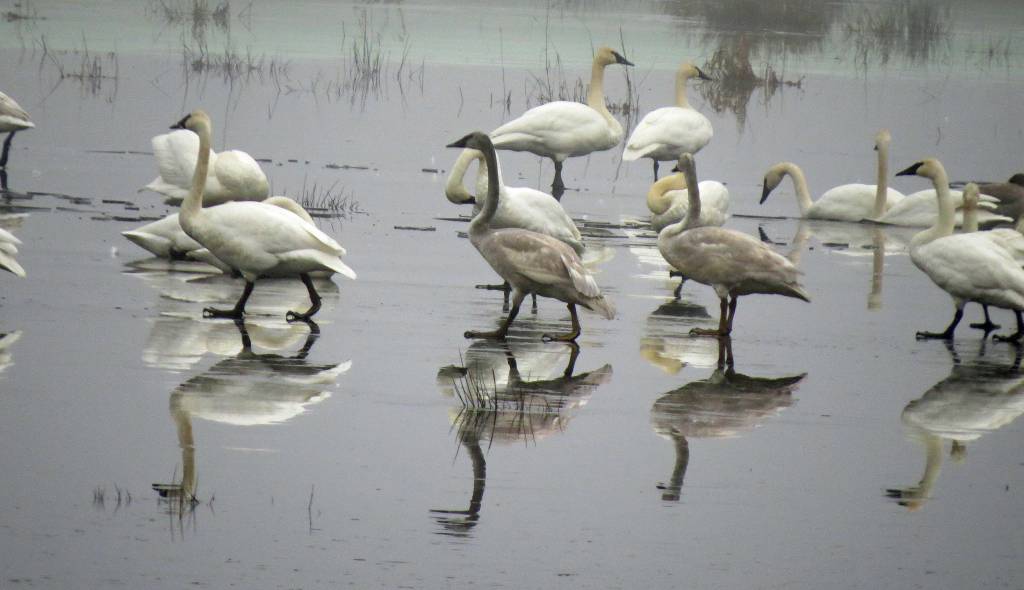
Trumpeter swans flying at sunset

Oh, and there’s a new kids’ animation movie out- beautiful graphics with doe-eyed creatures and a neatly packaged coming of age story.  “Never growing up” doesn’t have to mean arrested adolescence; rather, it can be the crazy dreams and imagined adventures of childhood. As someone stuck at age 10, with a collection of animal puppets and kids’ adventure books, I was sold.

So I stayed home, doing my usual weird routine of cooking a turkey after spending Thanksgiving with friends- just for the leftovers, mind you.  Filling the house with the scent of savory soup and freshly baked bread the next day. Raking up the last leaves, and wandering out with a camera when the light and animals cooperated.  A quiet, kinda sustainable holiday.  A break.


In the Pacific Northwest, fall brings windstorms and rain, sometimes in torrents.  If the jet stream from Asia lines up just right and picks up moisture from typhoons or other sources, an “atmospheric river” forms; meterologists describe it as a “firehose” when the mountains stall the front and  rain dumps continuously.  We’ve experienced two of these, one with a serious windstorm. Since resulting flooding occurred back-to-back, I’ll call it “round one”.

Flooded road and trooper of a fir tree

Flooded road and trooper of a fir tree

We survived round one despite crumbling dikes that bulged in seams indicating seeping from the river to the backslope. We survived the windstorm, too, with a short power outage and a few trees affected by 60-mph windgusts that came from an different direction than usual. I found front porch railings popped and discovered at morning light that the 30 foot tall Alaska weeping cedar had begun to tip over onto a porch post, leaving a rut where the roots were lifting out of the ground on one side. I will definitely be doing some work to help that tree build new roots and to beef up any barrier to keep it from tipping onto the house!

Dikes look dry, but seeping is occurring at the base of the slope

Dikes look dry, but seeping is occurring at the base of the slop

WindstormAftermath

Windgusts of 60 mph (95 km/h) from an unusual direction snapped this tree and tipped the top onto a neighbor’s roof. I usually evacuate before large floods, but with a horse suffering from deteriorating ligaments, a walk up the hill or trailer ride could exacerbate the problem, and will only happen if needed.

My reaction to these events is tempered by the sober realization that we all  signed up for this.  It’s not just that I moved to this place.  It’s that we altered this place to make it more hazardous during weather events.  We logged upstream and put in buildings and roads that shed more water into the rivers during storms. Tree canopies no longer slow the procession of rain to ground. We channelized the river, making it run faster and higher during floods.  We build “farmer engineered mountains of mud”: dikes that don’t conform to Army Corps standards, much less aspire to be the complex flood control of the Netherlands.  This was the dream of Dr. Henry Smith when he first saw the Snohomish River system:  a new Holland.  We are no Holland, but instead a patchwork of both sturdy and crumbling dikes holding water back from homes and hundreds of millions of dollars worth of infrastructure: jet fuel conveyance pipelines, massive water mains, high voltage power lines, communications cables sharing pole space with local utilities, commuter roads, and bridges.  We are a train wreck waiting to happen, a New Orleans or New Jersey waiting for the Big One.  And that other Big One- a massive earthquake expected at some time in our region- could liquefy our jello-esque dikes and send a tsunami 9 miles upstream.

Pulling a dock up before the floods take it away

Pulling a dock up before the floods take it away

So why do people live in places like this?  People live with natural hazards throughout our region because of the beauty, the diversity of activities, jobs, and the economy.  It’s a case of picking your poison:  windstorms, ice storms, earthquakes, tsunamis, landslides, volcanoes, coastal and river flooding, even drought.  Tornadoes and severe thunderstorms are rare events that pale in comparison to the intermittent massive weather and geological events that can whack us all.

People are flocking to this region:  my county is expected to absorb 200,000 more people in the next 20 years.  We will have to be a lot more proactive, get a lot more clever, and spend a lot more money to make this immigration wave work in an area that wants to blow up or just crumble into the sea.  For those of us who are already here, we’ll have to keep whistling past the graveyard and hoping for the best.


This slideshow requires JavaScript.

Calm river in early fall

Calm river in early fall

Autumn is a season of giving and a prelude to the fear winter brings.  Gentle storms wash loosen leaves from trees, to be gathered in piles for mulching summer-parched plants.  Fruits, berries, and seeds that escape the beaks of birds drop to the soil to become next year’s volunteers. Pumpkins and squash wither in the chill and spill meat and seeds when mice make holes in their softened husks. Throughout my little landscape, plants bed themselves down with needles and leaves that will cushion them when rains pound and nourish their growing roots as they sleep.

Rainbows Mean Rain

Rainbows Mean Rain

Some rain has fallen, an antidote to a terrible, dry summer with historic stretches of heat and skies smudged with wildfire ash. The rivers ran low and hot, choking fish and shutting down fishing. Berries mummified on branches and canes.  If we had lived in a time before grocery stores, we would worry

about the coming winter.

Calm river below smoky skies

Summer’s smoky skies- there are mountains behind that smog

After a couple rainstorms, plants bloom again as if spring has arrived.  Grass springs back to life in the emerald green of first warmth even as the days become shorter and colder. The harvest moon looms large over the damp pasture at night as young coyotes steal under fences, hunting rabbits and voles.

Hey wait! It's fall, not blooming time!

Hey wait! It’s fall, not blooming time!

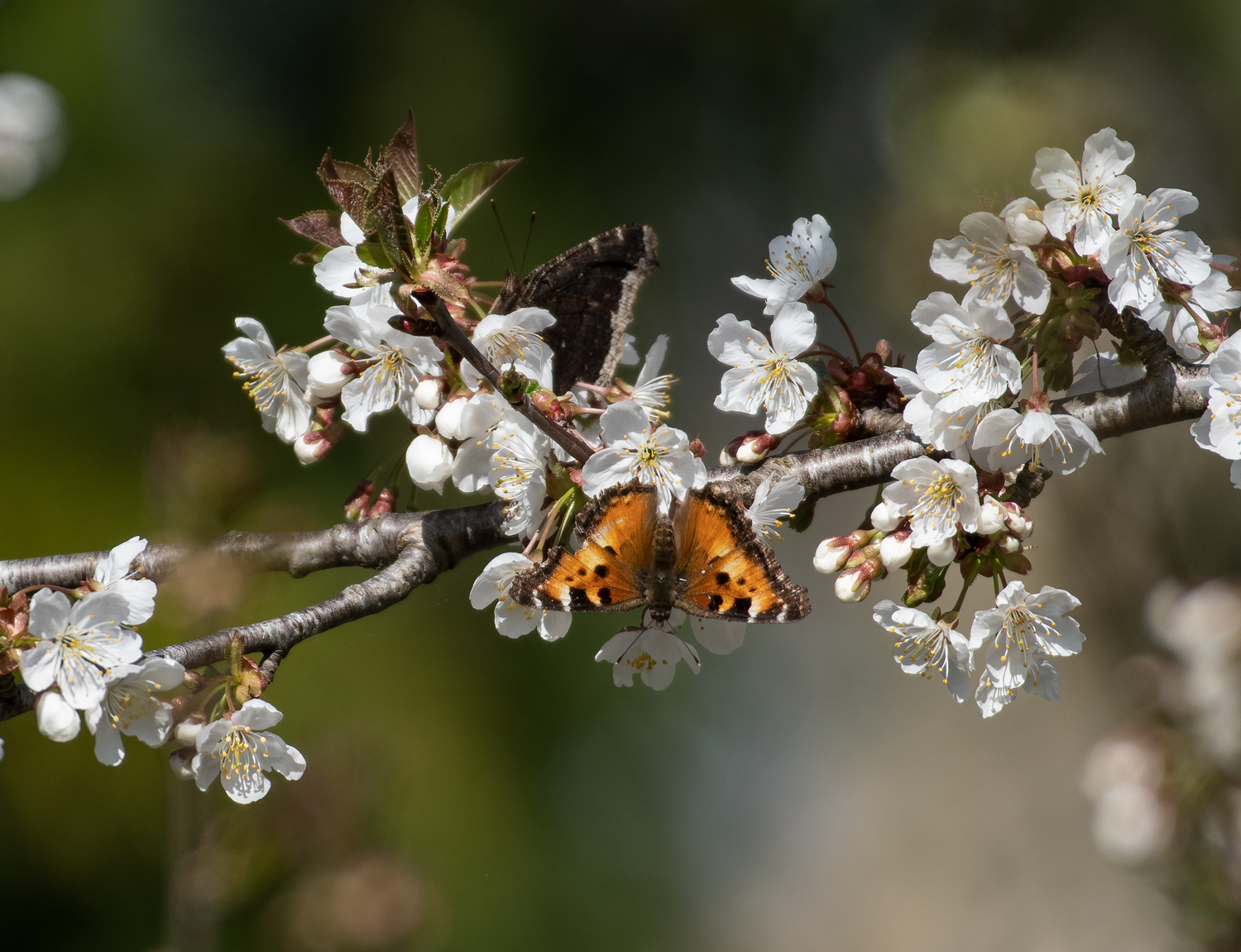
A late visitor- red admiral butterfly visiting a coneflower

A late visitor- red admiral butterfly visiting a coneflower

The barn swallows left after Labor Day, tiny agile pilots navigating the incredible journey to Central America.  Now snow geese are back from the opposite direction in the Arctic, their barking unmistakable on a foggy morning when they can’t be seen flying overhead.  A Stellars jay has returned after the summer, with its straggling imitation of a red-tailed hawk that impresses no bird foraging in the yard. A surprise visitor appears one sunny afternoon- a red admiral butterfly apparently affixed  to a coneflower bloom.  It seems late for this butterfly, but with an expanding crop of nettle to lay eggs on, it may be the product of multiple hatches this year.

Open-faced dahlias continue feeding bees

Open-faced dahlias continue feeding bees

Pacific chorus frogs croak from trees and shrubs on damp days.  There aren’t many frog-friendly days, what with the strong El Nino that is creating havoc elsewhere.  Here, we are still too dry.  My cedars are flagging, and a noble fir sacrifices needles on some branches that jump out visually when they turn yellow. Fall is usually a good time to plant trees and shrubs potted and tended over the summer, but this year, my shovel turns up dust a foot deep.

As I put my landscape to bed, clean gutters, and spread gravel in paddocks, I wonder what will be left on the other side of winter.  Will it be our turn for historic, destructive storms like the rest of the nation experienced this year?  Will my horse with his decaying ligaments still be alive?  Will the roof last, or will more windstorms peel off enough shingles to warrant an emergency repair? Will the river swell and breach the dikes with typhoon moisture from Japan, swept in on tropical winds from Hawaii? Or maybe we’ll sit parched all winter, with no snow for skiing this winter, or next summer’s river flows.

I’m always dubious about autumn- the gifts it presents are perhaps an apology for what comes next.  I’m sure people from time immemorial have looked askance at autumn, unsure of what the next months would bring. For thousands of years, people must have hoped for somewhere else to be the bullseye when the monster winter storm or evil deep freeze set in. They must have flipped a coin or a chunk of bone or a point carved of rock, anything to ward off the worst of winter while they still had a chance.  We’ll see.  We’ll see what’s left next spring.

Autumn Sunrise

Autumn Sunrise

This slideshow requires JavaScript.

IntotheWildAuyuittuq has only fragments of trail- bits that you celebrate like a delerious drunken sailor before they disappear into a gouged-out riverbank or a rockslide. You start out at Pangnirtung Fiord on sand and feel like this will be a super-easy trail. What’s that uneven ground they warned you about, anyway? And then you have to scramble over a rockslide with that heavy pack, pick your way down a jumble of rocks on a glacier moraine.  Even the most nimble of us did the dance to stay upright once or twice.  

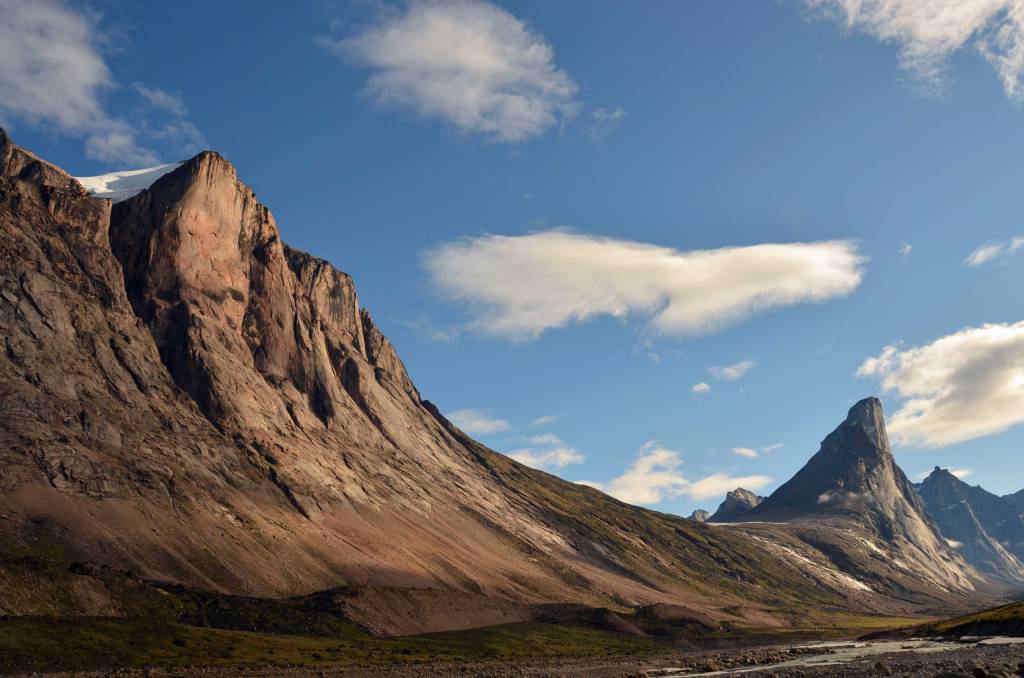
But for me, a couple days were an unending exercise in slipping, tipping, bruising, and cussing. If it weren’t for Mt. Thor watching over me, I might not have found a solution or salvation.

In late 2010, the orthopedic surgeon didn’t really think it was weird that I wanted to have my old hip joint as a souvenir, to take it with me on new adventures.  Apparently people who have replacement surgery at a young age  commonly have the same primitive desire to carry removed body parts in celebration of renewed life along as they continue traveling the world.

What I left behind was not just pain, disability, and degraded bone pitted and gnarled by chronic inflammation.  Using only the finest of carpentry tools, the good doctor carved out rotten bone and along with it, removed pressure sensors that help the brain tell where the leg and foot is.  While bird-watching a couple months after the surgery, I was looking up as I attempted to step onto a downward sloping plank across a water-filled ditch.  My brain just said “no” and my foot wouldn’t move. Hiking and scrambling in Death Valley National Park a month after that, the brain freeze effect was even more noticeable. At my three month check up, the attending doc looked quizzical, told me I was doing a little more than usual for a recovering patient, and said it would take 18 months to rewire as best as I could.

Life is better with fake parts- it's glorious to be walking in the clouds again

My first stint on crampons after surgery was at Mt. St. Helens, pictured at right.  I was frustrated by my inability to use different foot positions, but I made it.  I kept moving on foot, on skis, whatever I could use to keep going.  When I had to scramble with a pack over the roots and rocks on the way to Tuck Lake this summer, I was footsure and comfortable.

But there is a difference between uneven terrain and moving uneven terrain.  Rolling stones that gather no moss or lichens. Boulders perched on sand and gravel, all ready to let loose.  Parks Canada gives a thorough introduction when you register for the Auyuittuq hike, letting you know where it’s safe to cross moraines- Crater Lake by the Weasel, Windy Lake high up, by the mountain.  Look for paths with moss and lichens, Ranger Matthew said gently.  They’re more stable; they won’t roll from under your feet or onto you.

Oh, and watch for quicksand.

Well, I found that quicksand first, walking right beside Ruth but taking the wrong step on jello-ey wet ground before my foot plunged downward.  I tried to pull out the foot, but it felt like a creature underneath the soil had a death grip on my ankle.  Then my companions tried to pull me out- standing too upright, and I sunk further.  The burly guides hauled me forward, but by this time, my faux hip was compressed at an agonizing angle at risk of dislocation.  I cussed loudly- the only f-bomb audible on the trip-  because I couldn’t move from that cramped position and I hurt.  Finally, the guides had me remove my camera from my chest harness, lay forward on the mud, and they just dug my foot out of the mud.  Cheating.

The wrong way to deal with quicksand. Photo courtesy of Susan.

The wrong way to deal with quicksand. Photo courtesy of Susan.

That was more of a gee-whiz adventure compared to lurching over rolling rocks with the heavy pack.  I later figured out that if anyone walked behind me and I heard the clatter of their trekking poles, the labored breathing, I would rush and trip. With marginal balance, the heavy pack would tip me just a little and I was gone.  Down on my butt mostly, sometimes banging a knee or thigh. I’m pretty durable, so besides looking like a spotted cow because of the bruises, the only thing that truly suffered was my patience. the only thing that kept me going was Mt. Thor, watching impassively above the valley as I struggled like an insect below.

I’m a problem solver by nature and will take action when I get frustrated. I started walking behind the rest, looking at the rocks I wanted to use for a second before I put a foot on them.  When it was too complicated and my brain would freeze, I counted rocks to keep going:  one-and-two-and-three. It hurt my brain the day we hiked from Summit Lake to Turner Glacier Moraine to see if Mt. Asgard would appear.  One-and-two-and-three and four, all day long.  But it worked, reducing my crash-and-burn rate to almost zero.  And then, I realized something important.

We hiked down Windy Lake moraine to set up camp.  Can you see our path?

We hiked down Windy Lake moraine to set up camp. Can you see our path?

By hanging back, I had a little space all to myself for just a little while.  When I wasn’t staring at a succession of rocks, I could gaze at the towering mountains flanking the ancient glacier-carved valley.  The clattering of trekking poles and the chattering of voices just faded away.  It was my hike, my valley for those periods. I could stop counting one-and-two-and-three and sometimes just sing a song that felt like this place, wonder at its grandeur.

Rocks everywhere- hard to walk on, but good for wind shelter.

Rocks everywhere- hard to walk on, but good for wind shelter.

I’ve heard arguments that we shouldn’t be spending health care dollars replacing people’s worn-out parts, that people who get those parts shouldn’t do anything beyond power walking and strolling along easy trails, that we just need to accept the creeping disability of old age.  I’ll argue back that these parts provide pain relief safer than any opiate, return us from major disability to productive life, and -if we use them well- keep us healthier as we age.

My orthopedic briefly put down his carpentry tools to draft a letter approving me to take this trek.  And Mt. Thor watched- I imagine- with quiet approval as I roller-skated on rocks until I figured it out.  What more could I ask for?

Last season, it was all about the catching; this year it's all about the fishing

Last pink salmon season, it was all about the catching; this year it’s all about the fishing. But no famine will occur here: a buddy goes to Safeway grocery store to fill his smoker when he can’t catch enough wild fish.

In the Puget Sound region, we march slowly toward the lifestyle depicted in the science-fiction comedy Wall-E; Amazon will send a drone to your door soon so that your delivery arrives in an hour.  We deliver groceries and restaurant food, not just pizza.  Even middle class families have cleaning services.

With this much free time and choice, we can choose what shapes us, and ignore the land.  Oh sure, Western Washington has been cut off by major flooding, so that no supplies can enter the state by rail or road.  We’re prone to major earthquakes, and now overdue for a whopper that could bring us to our knees and change our region for decades.  We’re surrounded by volcanoes that could- and have- transformed in seconds from ethereal visions of white to exploding mountains of smoke and ash unleashing torrents of glacial meltwater and mud.

But these events don’t happen every year, so we forget that the land could put a stranglehold on our lives.  We survive power outages after windstorms, ice storms, and flooding. After Mt. St. Helens blew up, we buried the dead, built a visitor’s center at a new National Monument, and her ash became gift shop curios. Groceries always show up, and we carry on. We certainly need no taboos to avoid cannibalism in times of famine- most of us need diets instead.

Life is not this easy on Baffin Island, even now that people don’t rely on hunting to survive.  When we arrived in late July 2015, the jet stream that trapped historically hot weather over southern Canada and the U.S. held a cold front at its back resulting from a record cold “blob” in the Atlantic.  In Iqaluit and Pangnirtung, pack ice still cluttered the harbors, preventing the Sealift from delivering food and supplies.  Fuel tankers couldn’t reach remote communities; even those with reserve tanks were reportedly running low on fuel.

By the time we left Auyuittuq National Park, the Canadian government sent an ice breaker on emergency orders to make a path for a fuel tanker to reach Pang.  The tanker was there, but in a week, according to a government project manager, they have not been able to pump a liter of fuel.  Floating ice prevents a boat from extending a fuel hose to connect to valves on shore, and eventually, shears the cable to the anchor.  The freighter is under power instead of adrift as they scramble to get technical divers flown in.

Parks Canada Ranger Station, Pangnirtung, NU

Parks Canada Ranger Station, Pangnirtung, NU

The land still controls lives here but the people are not as bound to the land as before, when they depended completely on the bounty of the land to survive.  That bounty conferred great health on a durable and resilient people when it could be harvested, but there were times that food eluded people, when Nuliajuk, the temperamental goddess-like woman under the sea, kept sea mammals away from hunters.  The wonderful Inuit writer Rachel  A. Quitsualik says, “Inuit were concerned with whatever gave them a practical edge, practicing a humanistic, even somewhat scientific, observation of nature. Their preoccupation was mastery, not propitiation, of their environment.” Read more at http://indiancountrytodaymedianetwork.com/2003/05/15/inuit-deity-what-will-you-do-once-you-know-88777.

At least Pang has reserve fuel storage tanks

At least Pang has reserve fuel storage tanks

A tanker of fuel in Pangnirtung Fiord, skirting ice

A tanker of fuel in Pangnirtung Fiord, skirting ice


Although we experienced several rainy days on our trip to Baffin Island, this area is considered to be “in or near” the polar desert biome.  Like many deserts, where water flows there is life:  here, in the marine waters and fiords are  seals, whales, polar bears, walruses, and arctic char.  These animals are dwindling as everywhere due to the power of the rifle, and sometimes, the snowmachine.  Because the Inuit traditionally depended on this life for sustenance, dwindling populations may someday spell the end of selling some products commercially in order to sustain the Inuit people.  For now, they are here, and if you live outside the United States, you may bring home a sealskin bag, or sealskin wallet.  Because I live in the United States, I brought home a carving and a weaving of seals. You can get arctic char at Pangnirtung Fisheries to ship home, although I can’t imagine it is as good shipped as it is fresh.

People’s tastes change, though, and they have here, where there is less and less reliance on the bounty of the land.  From “the South”, they ship Pepsi, and when it doesn’t arrive because ice chokes harbors, it increases in price to $9 Cnd per can. I see cases arriving on the plane with people visiting from accessible communities.

ClammingLowTide I also see women out clamming at low tide when I hike the Pang headland, and we see seal hunters when we take a boat ride out to the floe ice by Cumberland Sound.  They are patiently working to gather a food source that is probably far healthier than most of the food on the stranded Sealink.

SealHuntingCumberland

It may be that the Inuit no longer need a shaman to appease Nuiliajuk, but instead, the Canadian government to bring an ice breaker or a cargo plane full of food.  What then happens to their diet, to their profound observational skills, to their rich oral history, stories passed down by the elders to help the young navigate life and the land? Projects like North of 60 and foundations like Students on Ice seek to preserve stories and traditions of the Arctic, and pass them on to the next generations. But can these efforts preserve the strengths, intuition, intellect, and skills that helped the Inuit survive without the need to work with the land?

I would never wish to consign people to a harsh condition when the rest of us have other options. However, I hope the Inuit can find a way to carry forth into their future the strengths and skills that sustained them when their land shaped the living, rather than abandon qualities most of us will never know to shape the land to their will.

Color and life in a barren land

Mountains, clouds, and ice guard the entrance of a rich, magical valley

Mountains, clouds, and ice guard the entrance of a rich, magical valley

In the Pacific Northwest, we tend to become hunched and dull during winter, when the slate grey days end too soon and the evergreen trees loom monotonously dark green. We board planes flying to sunny places, where light sparkles on snow or tropical oceans.  Or we just stay put and get depressed, drink too much coffee, and buy expensive lights for our desks.

Mt. Thor, shedding storm clouds

Mt. Thor, shedding storm clouds

This verdant weight felt lush and light to me as I drove back from SeaTac airport after returning from Baffin Island without having seen a tree for weeks. There, everything appeared to be ice, dangerously cold water, impassive peaks, jumbled glacial moraines, sand and rocks, rocks and sand.

Where glaciers once ground the rocks to flour sometimes looks lifeless and painful, like dry boredom.  Rocks and dirt are washed around by water, tipped by gravity to tumble down moraines, heaved by freeze/thaw.

CarpetLook closer and you will see a carpet of plant life spreading over rocks and dirt that finally stop moving: lush, deep carpets of moss and lichen, mushrooms, willows, grasses, and flowers.  Along Cumberland Sound, find lemon yellow Arctic sulfur butterflies and deep orange fritillaries by freshwater streams.

ArcticSulphurPang

Arctic Sulphur Butterfly- Pangnirtung headlands

In the Weasel River Valley, look up to see the warm streaks of iron across the charcoal and ivory surface of a mountain, or the warm wash of sun across the rocks or a wind-sculpted sand dune.  Find the iridescent sheen of bacteria thriving on iron and manganese rich water in puddles.  Delight in the abstract pattern of charcoal silt in a shallow stream.   Admire the faint gold of August evening light on the river braids.WeaselEveLight2

Around Crater Lake, pause to pick up rocks.  You will find crystals of every kind, shimmering finishes, all colors. These are rocks laid down by ancient lakes or thrown skyward by volcanoes, then heated under pressure to become gneiss, schist, quartzite, and slate.

The Pacific Northwest might wrap you in a soft cushion of greenery, so dense and comfortable that Midwest flatlanders like me never leave.  The seeming barren lands of the Arctic tundra drive you to action,  to seek beauty, drawing you onward with occasional flashes of beauty and brilliance.   Every day, once we set camp, I roamed looking for color and light.  When the pickup boat sped away down Pangnirtung Fiord, we looked back quietly at the grey fortress of mountains looming over the Weasel River Valley. Ruth said it was sad to leave the mystical valley, that she would miss just walking, eating, and sleeping, living a simple life in a beautiful place. I silently agreed as I imagined behind that curtain of rain flashes of red and gold, orange and pink, yellow and jet black.


Fortune cookie irony, opened at lunch on the third delay day.

Fortune cookie irony, opened at lunch on the third delay day.

This has been a historic year for weather in many areas.  My home, Washington state, has been hot and drought-stricken, resulting in failed crops and historic wildfires.  This post is a week late after a historic windstorm swept through, leaving me and 174,999 other people without power.  My power finally returned after 5 days when I finally got a live person on the line at the utility so I could explain that all I needed was a fuse replaced on the power pole.  She got a crew out promptly and the repair took all of 10 minutes.

Baffin Island was not spared the swing in weather, but it went the opposite way:  cold, with very late breakup of pack ice.  Cumberland Sound was coated with ice, here seen from the air. CumberlandSoundIcebergPlane Pack ice brings arctic fog.  Qikiqtarjuak was plagued with fog, Pagnirtung with wind.  Neither was conducive to plane travel.


I learned a lot on this trip about the level of adaptability and flexibility Arctic travel requires.  People writing brochures to attract folks to the Arctic try to balance attractiveness with alarm by letting you know that traveling in the Arctic may involve some delays.  What they need to tell you is that you need to research every air stop in case you get stuck in the town and need a place to stay and something to do.  You need to leave days of buffer on either end.  Parks Canada points this out on their Ivvavik Fly-in Trip informational package:

Due to variable weather, flights in and out of the park can be delayed. Parks Canada recommends that travellers allow for two or more days between the end of your Arctic Base Camp trip and your flight out of Inuvik. If your trip returns as planned, you’ll be glad to have some extra time to explore Inuvik.

This is a great way to frame expectations.

My recommendation after this experience- and my plan for next year’s arctic trip- are:

  • Get all your flights booked together!  That way, if one leg is delayed, they will shuffle all the downstream sections for you. I booked my Air Canada flight separate from the First Air flight that the outfitter booked.  When First Air was delayed, I lost my ticket on Air Canada (I cancelled, but ended up with only $100 toward a future flight due to fees). Make sure your airline ticket has a standby option (mine did not, probably noted in the multitude of small print)
  • Buy travel insurance, and make sure the limit is at least $1000; hotels in remote areas are expensive.  The outfitter’s policy allowed only $600, which I easily burned before the delays at the back end. 
  • Check before you go if your credit card has  travel insurance- mine does not.
  • Leave time at the back end to accommodate the range of delays you may experience coming in and going out.  Research the airport locations for things you’d like to see!

On this trip, we were a fairly adaptable bunch, but here’s the gap between the plan and reality that we faced (descriptions on the left are from the outfitter):Presentation1


Summit Lake Camp between rainstorms

Summit Lake Camp between rainstorms

The best lunch I’ve enjoyed in recent memory was delivered to my tent by guide Rhys Hill on a rainbound day at Summit Lake.  Hot bannock grilled with cheese and ham delivered in a plastic bowl to the vestibule, along with a bottle of glacier runoff water, fruit leather, and a chocolate granola bar from my snack bag made an unforgettable feast.

Lunch in my daily life now is usually forgettable.  I eat at my computer like many busy people, putting down calories without recalling what foodstuff contained those calories. Meals at home are more deliberate:  summer lunches eaten on the front porch listening to birds moving through the weeping cedar and crabapple, Sunday breakfast with hot coffee listening to the radio. All the same, I take food for granted most of the time, as only people in well-fed countries  can do.

Rainy day room service, Summit Lake camp, Auyuittuq National Park

Rainy day room service, Summit Lake camp, Auyuittuq National Park

But when a body is burning energy daily and the world is simplified into eat, sleep, walk, and stay warm, a hot lunch is everything.  When  clouds sit on top of a temporary nylon home, pelting the shelter with rain and wind, lunch is a highlight of the day, comfort and sustenance, survival.

Our plan was to camp at Summit Lake, day hike the following day to the Turner Glacier to see the famous Mt. Aasgard;  the Mt. Aasgard of the James Bond movie The Spy Who Loved me. By this point in the trip, I had committed to brooding, magical Mt. Thor as my favorite, but we were still exploring as much of the traverse as we could despite the travel delays.

The day hike to the Turner didn’t happen the first day we intended.  We joked about the polar desert environment over breakfast, after living through wind and rain all night.  I had slept quietly, but others were kept awake by the flapping of the solid but noisy Hilleberg tents – even if they were sleeping in their own tents, and the Hilleberg was someone else’s.  After breakfast, our plans unraveled and we were chased back into our tents by another round of stormy weather. Everyone withdrew to write, read, sleep, or look at photos.

The lunch delivery was a welcome treat.  I didn’t want to burn any more camera battery, and I was struggling to write in the small Rite-in-the-Rain book I’d carried with.  My writing was not florid prose, but notes, cue words, and pen sketches written with a crabbed, cold hand as I hunched over.

OldCaribouAntlersSometime after lunch, the rain gave us a break for the afternoon and dinner before chasing us back into our tents.  Some of us went hiking.  I followed Trond and Ruth northward, but decided not to try following the gracefully rock-hopping Norweigans over the high point they chose to cross over a creek.  I backtracked to the Summit Lake moraine to find the caribou antler Ruth had picked up the day before. There are no caribou in the area anymore, and a hunting ban is in place indefinitely because populations have dropped 95% since the 1990’s, down to a herd of only 5,000 animals. According to CBC report, natural migration in addition to over-harvest due to the “reach of snowmobiles” is to blame.  Even pro-hunting legislators lined up to protect the remaining animals and work to establish a sustainable management plan.

The antlers left in this area are mostly old ones, yellow like this, though Trond found a big, white, complete rack by the Half Hour Creek emergency camp area.

PeekabooAasgardTurnerGlacierWe hiked the next day to the Turner Glacier to see if we could catch a glimpse of Mt. Asgard.  Micheil said the Turner River, something we weren’t keen to cross, had moved since he last saw it.  A central moraine with ice beneath a thin layer of rock stood allowed us to ascend to a spot where we could see the famous mountain. Mt. Asgard is there, behind that cloud, to the left of the rock teeth above the ice of the Turner Glacier.  Really.  It’s like Mt. Rainier, the famous volcano in my state:  you can work in an office for an entire winter and not realize your window has a great mountain view until the clouds clear and the sprawling, glacier-clad mountain looms large and white.  Really.  Others in my group pictured silhouettes of Aasgard, but I did not.  Standing on the rock-studded icy moraine of the Turner, I was happy to have made the place, and missed the somber and thoughtful Mt. Thor.

Even with the marginal weather, the rich orange-red of the iron-streaked terrain glowed against the gray mountains and sky.  Equally warm was the joy of traveling with a lighter pack-  though I was admittedly no more nimble and balanced than when I was carrying all my gear and shared food on my back.

IronRocks


Our camp at Summit Lake was lovely between storms, with mountains all around. My spot wasn’t the most comfortable.  Tucking in behind Susan’s tent along a rock wall helped break the wind a little, but the ground beneath me was uneven.  My warm ultralight Thermarest and ability to sleep regardless saved me during three nights at this location.BreidablikHwyGlacierEve

At every camp,  the simple things were all that counted like pitching the tent to put a layer of nylon between us and the wind. The tents might have been flimsy shelters, but the psychological comfort they provided was very real. Food counted a lot, no matter what it was.  No mindless meals working at a computer; we carefully watched Micheil and Rhys cook, contemplated how much fat we could add to a meal in the form of cheese or peanut butter, relished every hot meal.   Sure, the outfitter brochure promised pine-nut pesto, and the food barrels that never met up with us due to flight problems held bacon, wine, and rich desserts of pears to be drizzled with Grand Marnier-laced chocolate sauce. But for us, burning calories to stay warm and carry heavy packs over rough terrain , an extra piece of Co-Jack cheese on a bowl of chili, or a hot grilled sandwich consumed inside a rain-whipped tent was an incomparable feast.

This slideshow requires JavaScript.